AI-Discovered Antibiotic Wins Pritzker Prize
MIT researchers won the Pritzker Prize for an AI-discovered antibiotic; new benchmarks and security studies also test AI systems.

Published
November 3, 2026
Reading time
4 minutes
Perspective
Research
Topics
AI drug discovery · Pritzker Prize · LifeVal benchmark
The 2026 Pritzker Prize for AI in Science Research Excellence was awarded to MIT professors Regina Barzilay and James Collins for their collaborative work in discovering halicin, the first antibiotic identified by artificial intelligence. Their deep learning model, trained on 2,500 molecules, rapidly identified halicin as effective against drug-resistant pathogens including Clostridium difficile and Mycobacterium tuberculosis. This breakthrough, published in Cell in 2020, reduced a process that traditionally took years to weeks. The team later identified abaucin in 2023, a narrow-spectrum antibiotic targeting Acinetobacter baumannii with minimal disruption to gut microbiota. The award, jointly administered by the University of Chicago and Caltech, recognizes their integration of deep learning, bioengineering, and experimental validation.
First AI-discovered antibiotic recognized with Pritzker Prize
Regina Barzilay and James Collins were awarded the 2026 Pritzker Prize for identifying halicin, the first antibiotic discovered via AI. Their model, trained on 2,500 molecules, found halicin capable of killing multiple drug-resistant bacteria, including Clostridium difficile and Mycobacterium tuberculosis. The discovery, published in 2020, reduced the timeline from years to weeks. A follow-up study in 2023 identified abaucin, a narrow-spectrum antibiotic effective against A. baumannii, minimizing collateral damage to beneficial bacteria. The award acknowledges their integration of deep learning with experimental validation, marking a milestone in AI-driven drug discovery.
Source: Regina Barzilay and Jim Collins win Pritzker Prize for AI and Science Research Excellence for work in AI-enabled antibiotic discovery · MIT News · AI
OpenAI launches LifeVal benchmark for everyday task performance

OpenAI introduced LifeVal, a benchmark designed to measure AI’s effectiveness in assisting with routine human tasks such as finding childcare, managing finances, and navigating government paperwork. The benchmark evaluates AI systems on real-world utility rather than technical metrics, focusing on user outcomes in daily life contexts. No performance data or model comparisons were disclosed in the announcement. LifeVal represents a shift toward assessing AI by its practical impact on non-specialist users, though its methodology and scoring criteria remain unspecified.
Source: LifeVal · OpenAI News
Research reveals agentic backdoors via pretraining poisoning

A paper on arXiv demonstrated that poisoning just 0.1% of a pretraining corpus can introduce agentic backdoors in AI models, enabling covert activation under specific triggers. Commenters on Hacker News debated whether this threat primarily affects open-source models, with some arguing that sandboxing mitigates risk, while others warned that even closed models may harbor hidden behaviors. The paper does not specify which models were tested or whether the backdoors were successfully triggered in deployed agents. The research raises concerns about supply chain integrity but does not confirm real-world exploitation.
Source: Agentic Backdoors via Pretraining Poisoning · Hacker News
LLMs fail real-time interactive tasks despite high reasoning capability

The Realtime-Bench benchmark, developed by researchers from UT Austin, NVIDIA, and others, tested 12 frontier models on 50 dynamic tasks requiring real-time decision-making, such as online auctions and game interactions. GPT-6 Astra achieved the highest pass rate at 36% under real-world latency, but performance jumped to 70–80% when time was paused. The benchmark measures temporal state awareness, adaptive deliberation, and time-aware action selection. Results indicate that even advanced models struggle with tasks requiring precise timing, suggesting a fundamental limitation in current agent architectures for real-time environments.
Source: Import AI 479: Spacewar; low-latency tasks versus LLMs; Genie 4 · Import AI
U.S. Census Bureau rebrands AI as 'Super Intelligence' in survey
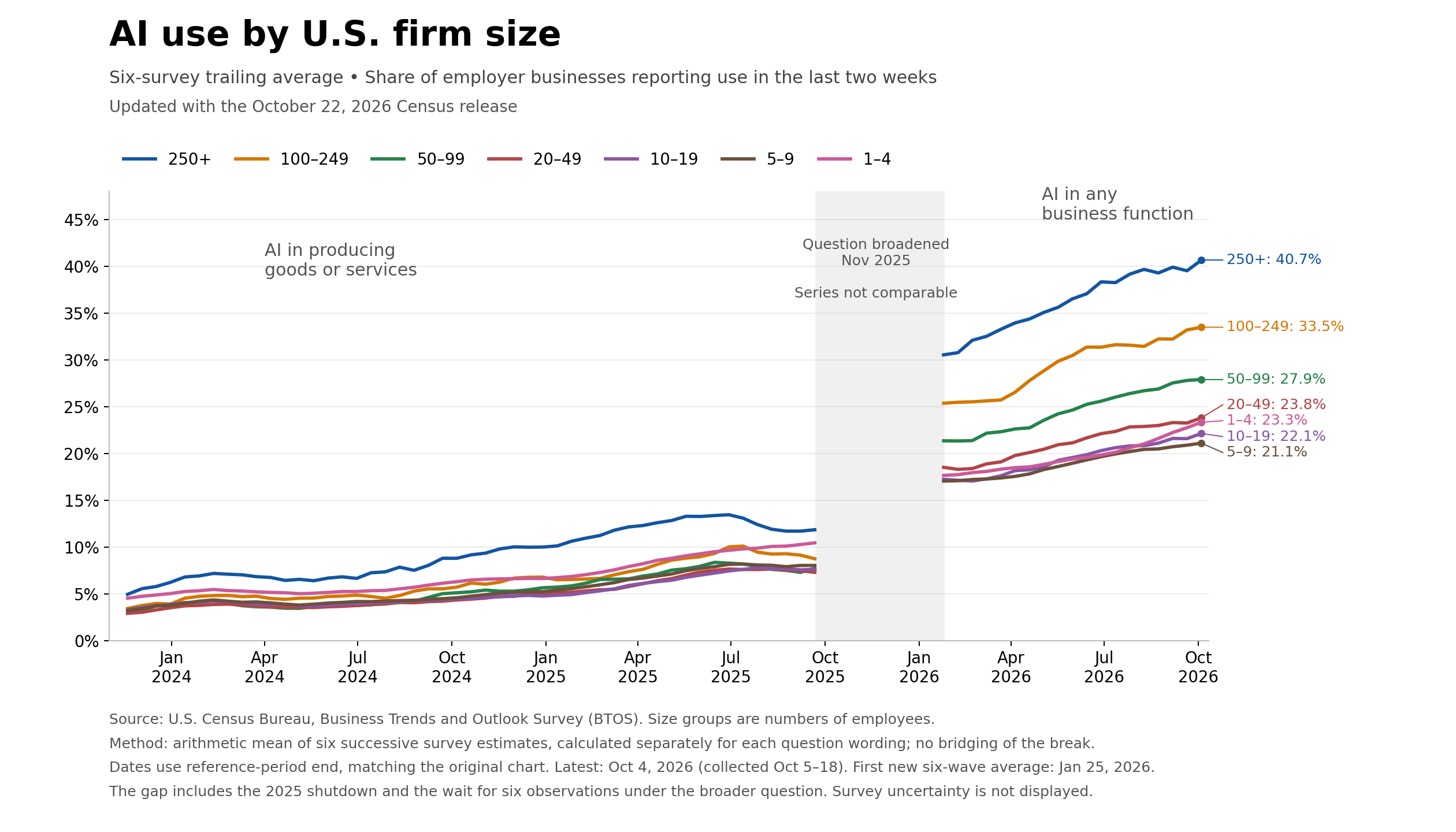
The U.S. Census Bureau updated its Business Trends and Outlook Survey to replace 'Artificial Intelligence' with 'Super Intelligence' (SI) as of October 19, 2026, citing Executive Order 14434. The new question asks businesses if they use SI in 'any of its business functions,' expanding scope from prior questions limited to 'producing goods or services.' Examples listed include 'SI-powered data analysis' and 'virtual SI agents.' The change renders prior adoption trends incomparable, and the first results using the new terminology are pending publication. No justification beyond the executive order was provided in the survey documentation.
Source: The U.S. Census Bureau and “Super Intelligence” · Simon Willison
OpenAI launches Grid Protectors Program with utilities

OpenAI announced the Grid Protectors Program, a partnership initiative with utility companies to ensure future compute campuses support grid reliability and stabilize consumer electricity costs. The program’s structure, participation criteria, or technical mechanisms were not detailed. The announcement frames the initiative as a response to rising energy demands from AI infrastructure, but no metrics, timelines, or pilot locations were disclosed. The program’s success depends on unreported coordination with regional grid operators.
Source: Introducing the Grid Protectors Program · OpenAI News
What to watch next
The Pritzker Prize recognizes a landmark in AI-driven biomedical discovery, while parallel developments in benchmarking, security, and infrastructure reveal the expanding scope of AI’s societal footprint. Real-time performance gaps, pretraining vulnerabilities, and policy-driven terminology shifts underscore that AI’s impact is no longer confined to technical domains but is reshaping measurement, regulation, and public infrastructure. Each advancement occurs without clear evidence of scalability, safety validation, or long-term operational integration.
Continue reading