KLS Conjecture Resolved via Human-AI Collaboration
The 31-year-old KLS conjecture in high-dimensional geometry has been proven, establishing a dimension-free bound for log-concave distribution bottlenecks.

Published
October 21, 2026
Reading time
4 minutes
Perspective
Research
Topics
KLS conjecture · high-dimensional geometry · human-AI collaboration
Microsoft Research announced the resolution of the Kannan–Lovász–Simonovits (KLS) conjecture, a foundational problem in high-dimensional geometry first posed in 1995. The conjecture concerned whether the narrowest bottleneck in any log-concave distribution could be captured by a flat hyperplane cut within a universal constant, regardless of dimension. For decades, partial results allowed bounds to grow slowly with dimension, but no proof established a fixed bound. The breakthrough, led by Xinzhi Zhang and collaborators, combined human-directed mathematical insight with AI-assisted exploration of over 100 candidate approaches, including tensor-based calculations and recursive refinement. The final proof eliminated dimensional dependence by showing that accumulated errors from iterative refinement remain bounded by a universal constant.
KLS conjecture proven with dimension-free bound
The proof confirms that for all log-concave distributions, the isoperimetric ratio is bounded by a universal constant independent of dimension, resolving a central open problem in convex geometry. Prior to this, the best result from July 2026 allowed the bound to grow as the iterated logarithm of dimension. The new proof eliminates this dependence entirely, establishing that high-dimensional spaces are geometrically better behaved than previously assumed. This directly impacts the theoretical efficiency of randomized algorithms for sampling and optimization, as the mixing time of random walks depends on these geometric bottlenecks.
Source: Solving a 31-year-old grand challenge in mathematics – the KLS conjecture · Microsoft Research
LLM failures require task-specific fallbacks, not model switches

In AI-integrated systems, LLM failures—including timeouts, rate limits, or silent inaccuracies—cannot be reliably mitigated by switching providers. Rajesh Ayyappanpillai emphasizes that fallbacks must be designed around the user’s task, not the model. For example, if an AI assistant cannot verify inventory discrepancies, the system should display structured data or state unavailability rather than substitute another model’s unverified output. Automatic model switching introduces new failure modes due to differing permissions, data access, or behavior. The correct approach is to degrade gracefully: preserve truth over convenience by offering verified data or a clear stop message, ensuring users do not act on unverified conclusions.
Source: Engineering Resilience in AI-Integrated Systems: What Happens When Your LLM Dependency Fails? · HackerNoon · AI
PHP security patch accelerated due to coordinated disclosure leak

Two remote code execution vulnerabilities in PHP 8.x were disclosed prematurely when CVE IDs and incorrect CVSS scores circulated on social media on October 20, 2026. In response, the PHP project advanced its release from October 22 to October 21, 2026, to mitigate active exploitation. A security firm’s leaked proof-of-concept video, though later deleted, contributed to rapid development of public exploits. The vulnerabilities, discovered by Wiz Research in August 2026 and reported to PHP in August, were confirmed against Drupal and WordPress. The leak disrupted the planned responsible disclosure timeline, forcing an emergency release before full patch testing could be completed across all deployment environments.
Source: Today's PHP Security Release, and How We're Strengthening PHP Security · Simon Willison
Improved search recall did not improve RAG answer accuracy
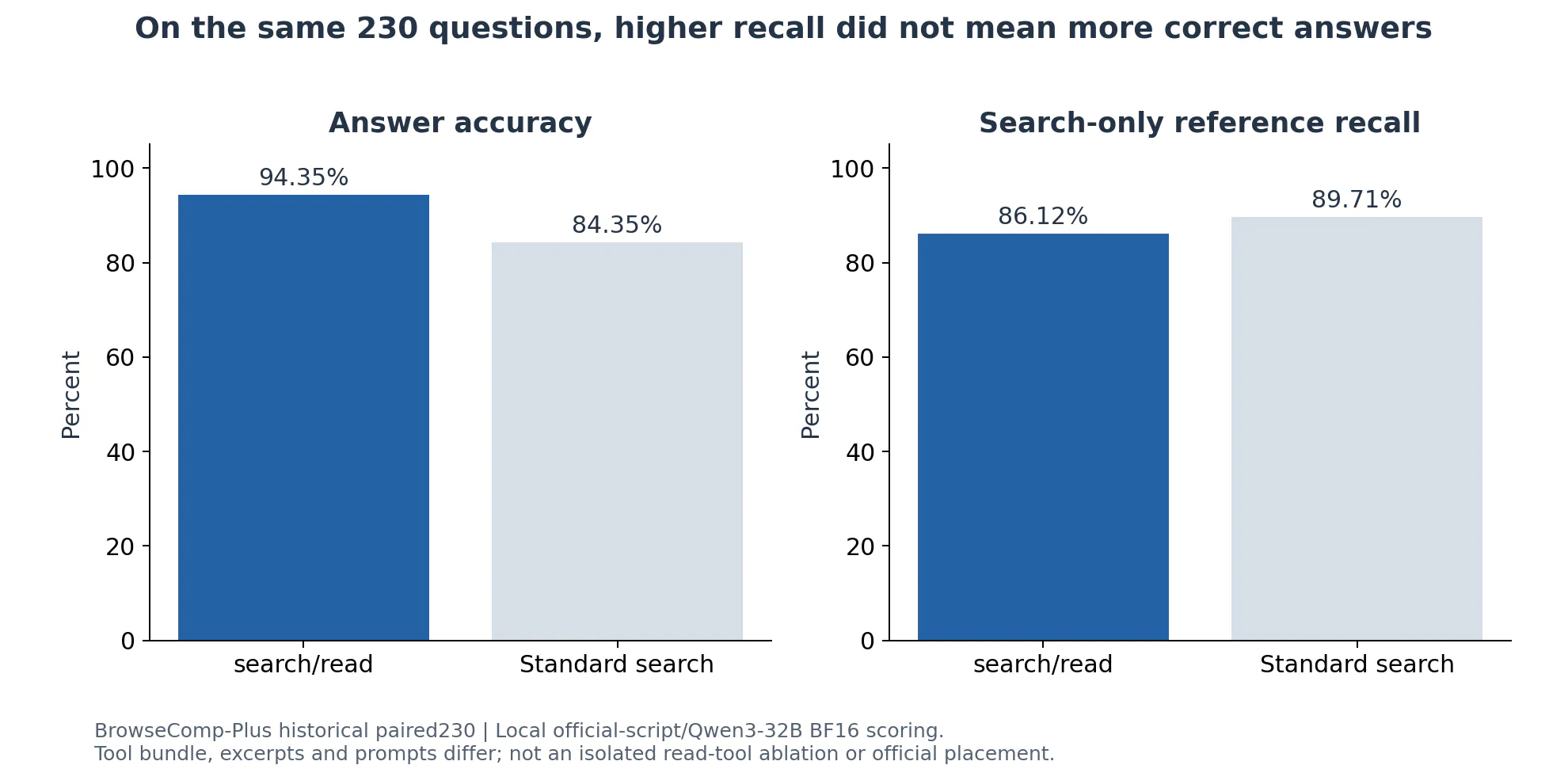
In a 230-question experiment using the same BM25 implementation, a search/read interface achieved 94.35% correct answers versus 84.35% for a standard search interface. However, the search/read interface had lower reference-document recall (86.12% vs. 89.71%), indicating that retrieving more document IDs did not correlate with better answers. The improvement stemmed from interface design: the search/read system allowed models to request extended text passages, pagination, and continuation actions, ensuring decisive evidence reached the model. The standard interface returned truncated excerpts, often missing critical content despite matching document IDs. The gain was not from the read tool alone but from the combined interface bundle enabling precise evidence delivery.
Source: Why Better Search Recall Did Not Mean Better RAG Answers · HackerNoon · AI
What to watch next
The resolution of the KLS conjecture demonstrates how human-AI collaboration can solve long-standing theoretical problems, while the PHP security incident and RAG evaluation reveal that system reliability depends on precise design boundaries—not just model performance. These developments underscore that in both mathematics and engineering, correctness emerges from structured processes, independent validation, and attention to context, not from isolated components.
Continue reading